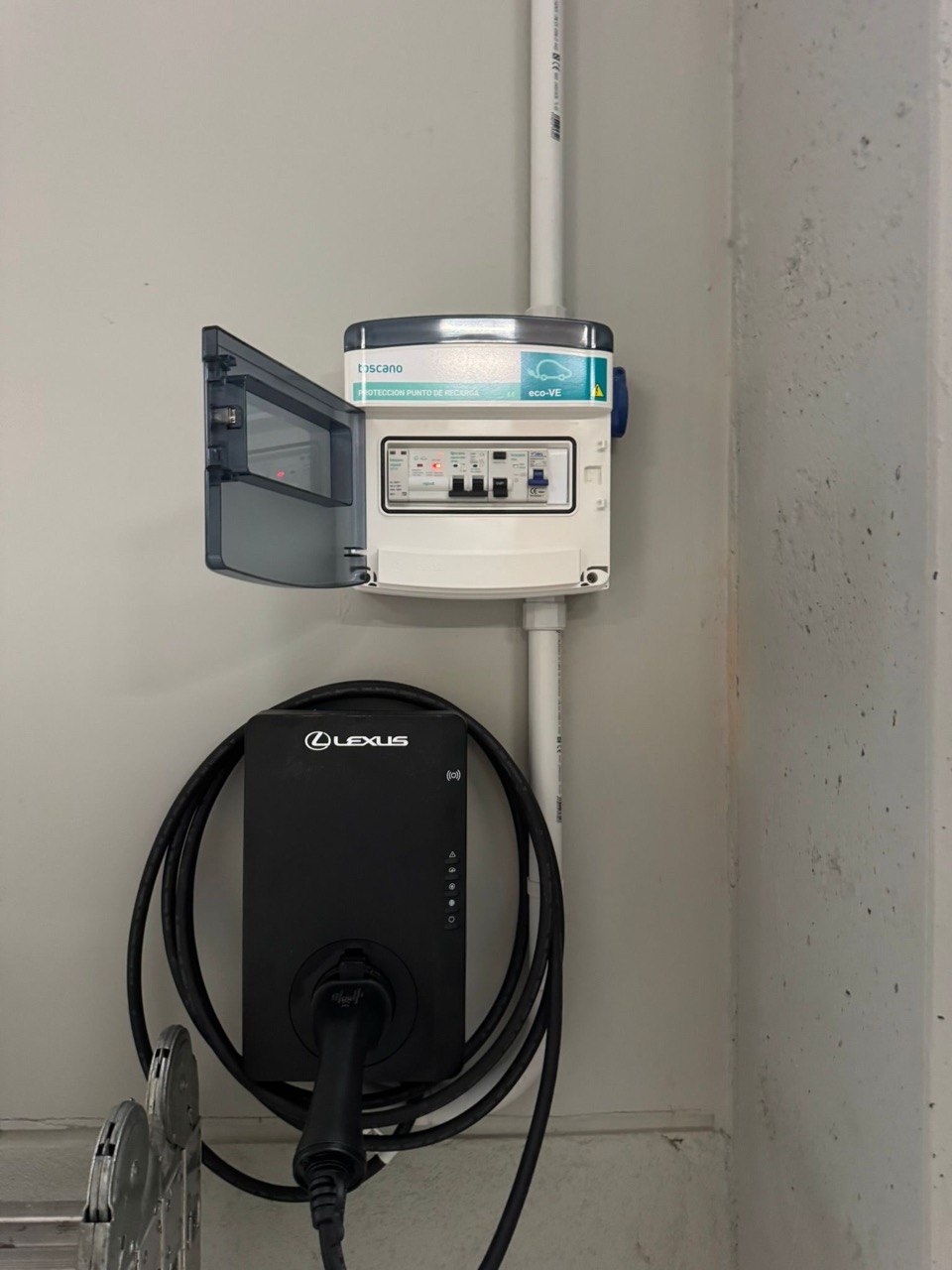
1. Where is the charger, actually?
Inside the car itself. A home charging station is a smart switch: it checks that everything is safe, supplies alternating current and tells the car how many amps it can draw. That is why charging speed depends on both the station and the car.
2. Can I charge from a regular socket?
Yes, if it is on a dedicated circuit used only for the car: cable of at least 2.5 mm², a 10 A circuit breaker (16 A only if the socket manufacturer allows it), a 30 mA type A RCD and surge protection. But it is slow: about 10–15 km of range per hour.
3. Which charging station should I choose?
- Single-phase, 7.4 kW — 35–45 km of range per hour; the car is fully charged overnight.
- Three-phase, 22 kW — if your home has a three-phase supply. But check how much power your car accepts: often it is 7.4 or 11 kW.
Useful features: dynamic load management (the station reduces the current automatically when the house is using a lot of power), an app, scheduled night-time charging, and solar panel integration.
Installation requires: a dedicated circuit (usually 6 mm²), a 32 A circuit breaker, a 30 mA type A RCD and surge protection.
4. Do I need to increase my contracted power?
Usually not, if the station has load management. But with only 3–4 kW contracted, charging will be very slow, so it is better to increase it. With the 2.0TD tariff you can raise just the night-time power, which is cheaper.
5. Can a charging station be installed in any home?
In almost any. Some upgrades come first if:
- the house has no earthing — without it, a station cannot be installed;
- the supply line or main breaker cannot handle the extra load;
- the electrical panel is outdated or lacks the required protections.
We inspect your home beforehand and tell you honestly what needs to be done.
6. How much do 100 km cost when charging at home?
About €3.80 per 100 km, compared with €11.20 for a petrol car. Driving 15,000 km a year, you save about €1,100. Charging at night or with solar panels is even cheaper. Based on November 2026 prices.
7. What financial incentives are there for installing a home charger?
- 15% IRPF (income tax) deduction — up to €600. The installation must be completed by 31 December 2026 and paid by card or transfer, not in cash.
- Municipal tax discounts — up to 90% on ICIO, up to 50% on IBI, up to 75% on vehicle tax. They depend on your ayuntamiento (town council).
- Direct subsidies for home charging are not available at the moment.
8. What documents do I need?
A memoria técnica (technical report), the boletín (electrical installation certificate) and its official registration (in Catalonia, in RITSIC), plus the invoice and proof of non-cash payment. Apply to your ayuntamiento for the ICIO discount before work starts.
Electro Life Spain installs charging stations turnkey and handles all the paperwork for you. Want to get the deduction in 2026? Book your inspection early.